

The internet has always been a weird place. Brands, however, have only recently figured out that leaning into that weirdness might be their best marketing move yet. They’re threatening customers with cartoon owls, selling water under a death metal aesthetic, and building entire identities around not taking themselves seriously. It’s called “unhinged marketing” and for companies targeting Gen Z, it might just be the smartest move they can make.
The Pioneers: Brands That Did It First (and Best)
To understand why unhinged marketing works, it helps to look at the brands that wrote the playbook.
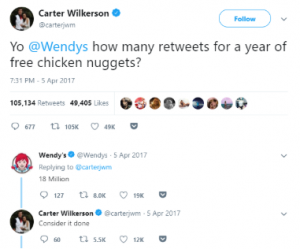
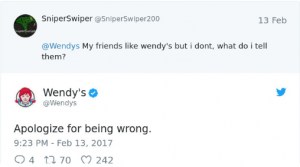
Wendy’s is widely credited with firing the starting gun. In January 2017, the brand ditched its standard corporate social media tone for something sharper and more combative, after recognising that younger audiences gravitated toward humor and authenticity on social platforms. What followed became legend: the #NuggsForCarter campaign, in which Wendy’s challenged a Twitter user to reach 18 million retweets for free chicken nuggets for a year, became the most retweeted tweet of all time until 2019, knocking Ellen DeGeneres’ famous Oscar selfie off the top spot, and attracting support from Apple Music and Microsoft. The financial results over that period were hard to argue with. Wendy’s net income rose from $129 million in 2016 to $194 million in 2017, though naturally a company’s bottom line reflects many factors beyond any single campaign. Their social following grew just as fast: Twitter followers climbed from 2.1 to 2.4 million in just six months. The social strategy had a simple internal logic: by eliminating the strenuous bureaucratic approval process for their Twitter account and empowering their social team, Wendy’s transformed the account from a one-way communication machine into something that felt genuinely alive. Turns out, letting your social media team actually be funny is a good business decision.
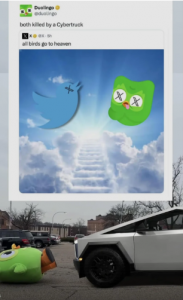
Duolingo then took that blueprint and ran it somewhere far stranger. From the beginning, the brand’s owl mascot Duo had a unique social media presence, acting more as an influencer than merely a logo for a large corporation, becoming famous for an unhinged sense of humor and a knack for jumping on the latest trends. The whole thing culminated in February 2025 with one of the most audacious marketing stunts in recent memory. On February 11, Duolingo users found their familiar green owl mascot dead, tongue out, eyes replaced with cartoonish Xs, marking the start of one of the most bizarre and viral campaigns in the app’s 14-year history. The company released a series of mournful social media posts, including a video of Duo being fatally hit by a Tesla Cybertruck, followed by other Duolingo mascots holding his funeral and then being killed off too. Users were then directed to a website where completing language lessons could “bring Duo back.”
The numbers that followed were genuinely ridiculous. On the day of the announcement, mentions of Duolingo’s mascot spiked by around 25,560%, and the hashtag #ripduo was used more than 45,000 times. According to digital market intelligence firm Similarweb, global downloads on Android jumped 38% the day after the campaign launched and web searches increased by 58%. On iOS, it was the highest number of worldwide downloads for Duolingo all year. By the brand’s own account, news outlets around the world published 450 articles about Duo’s death, 60% of which came from what Duolingo defines as top-tier publications, making it a bigger earned media moment than Duolingo’s own 2021 IPO.
And before anyone calls it a happy accident: Duolingo’s spokesperson confirmed to NPR that “at its core, this campaign was about engaging our community in a way that only Duolingo can, by making entertaining content that reminds our fans to do their lesson.” Marketing professor Matt Williams, a former CEO of the Martin Agency, assessed it plainly: “By using the Owl’s resurrection as an incentive for more users to do their lessons, Duolingo spiked engagement with their product. And they did it in a way that’s completely consistent with the Owl’s character. That’s a win for the business and the brand.”
Why Gen Z Demands Something Different
The stakes for reaching Gen Z have never been higher. According to Bank of America projections cited by EMARKETER, the generation’s global spending power is set to grow from $2.7 trillion in 2024 to $12.6 trillion by 2030, making them the most consequential consumer cohort marketers have ever faced, if those estimates prove accurate.
Getting their attention through traditional advertising, though, is a lost cause. Gen Z is most likely, compared to every other generation, to use social media for product discovery, and being product-centric is one of the attributes they care about least in brand posts. The hard sell doesn’t just fail to work. It actively puts them off.
What they want instead is to be entertained. Marketers need to prioritise content that entertains and makes audiences feel seen, with products integrated into the story as relevant.
The Platforms Shaping the Chaos
Knowing where Gen Z actually spends its time matters here. According to Sprout Social’s 2025 Index, 89% of Gen Z social media users are on Instagram, 84% on YouTube, and 82% on TikTok, and Gen Z consumers report TikTok is their favourite channel for product discovery, closely followed by Instagram.
These platforms reward spontaneity, humour, and native internet fluency. A brand posting polished corporate content gets scrolled past in seconds. A brand posting something genuinely strange gets shared to group chats.
Sprout Social’s Q4 2024 Pulse Survey found that 48% of Gen Z consumers plan to make more purchases through social media in 2025 than in 2024, with TikTok Shop leading the way. Social media is no longer just a discovery channel. It’s the storefront. Which means the content living there needs to work harder than ever.
What the Research Says About Gen Z and Authenticity
Academic research backs up what marketers are learning the hard way. A 2025 paper published on SSRN synthesises industry reports and brand case studies to identify authenticity, short-form video content, and purpose-driven branding as the dominant forces reshaping how brands engage with Gen Z.
Authenticity is the key word. Gen Z values authenticity and community, often using platforms like TikTok and Instagram to express themselves and discover new products. User-generated content and micro-influencers with niche, engaged audiences consistently outperform polished campaigns, because they feel real.
Unhinged marketing, at its best, taps directly into this. The chaos is a signal: we’re not performing a brand, we’re just here. Whether that’s genuine or a very sophisticated performance of genuineness is, perhaps, beside the point.
The Risk Calculus
None of this means every brand should immediately start faking the death of a beloved mascot. The strategy demands a real understanding of your audience, consistency of voice, and a tolerance for risk that not every organisation has. Gen Z is a cynical generation and they can spot a brand awkwardly attempting internet culture from miles away. The backlash, when it comes, is swift and merciless.
Sprout Social’s Q1 2024 Pulse Survey found that 57% of Gen Z took a social media detox in 2023, and 63% planned to in 2024, the highest rate of any generation. A cohort that is simultaneously the most active on social media and the most likely to log off is one that demands brands earn their attention rather than assume it.
The brands winning with chaos aren’t simply being random. They’re being precisely, strategically weird in ways that resonate with a generation that grew up fluent in memes, irony, and the particular humour of the internet. Getting that right is less a creative accident than a discipline. And as Gen Z’s spending power keeps growing, it’s a discipline that brands can no longer afford to ignore.
Be Human. Actually Human.
Here’s the thing that all the data, case studies, and marketing frameworks eventually point back to: people want to talk to people. Not brand accounts. Not corporate entities carefully managed by a committee of seventeen. People.
Wendy’s didn’t go viral because they had a bigger budget than McDonald’s. They went viral because someone, somewhere in their organisation, was given permission to be genuinely funny online and trusted to pull it off. Duolingo didn’t dominate the cultural conversation around the Super Bowl by buying an ad slot. They did it by killing a cartoon owl in a Tesla Cybertruck and making millions of people feel something about it. Industry observers noted at the time that the key was engaging audiences as active participants, not passive viewers. A principle that sounds obvious until you look at how few brands actually manage it.
That distinction matters more than any tactic, trend, or platform strategy. Nearly 40% of Gen Z consumers trust influencers more than they did a year ago, and Gen Z is more likely than any other age group to say that influencer content has the most impact on their decision to buy a new product. What they’re actually responding to isn’t influencers specifically. It’s the feeling of being spoken to by a real person, with a real perspective, who actually understands their world.
The brands that get this right aren’t asking “how do we go viral?” They’re asking something much harder: “who are we, and do we actually know who our audience is?” The unhinged stuff only works when it’s rooted in a genuine understanding of the community around a brand. Without that foundation, it’s just noise. Expensive, cringeworthy noise that ends up getting screenshotted and mocked in the very group chats you were trying to reach.
So no, you probably don’t need to fake the death of your mascot next quarter. But you might want to start by asking whether your social media could pass the most basic test of all: would a real person, scrolling on their lunch break, stop and actually care? If the honest answer is no, no amount of chaos will fix it. The good news is that the bar for feeling human online is, somehow, still remarkably low. The brands willing to clear it are the ones writing the next chapter of this story. The ones that aren’t will keep boosting posts and wondering why nobody’s listening.





 Cookies configuration